FDM 3D printing for the home
· breq.dev

I’ve owned a 3D printer for about ten years now. I got my first 3D printer, a Monoprice MP Select Mini, when I was in middle school as the 3D printing craze was beginning to take off in “maker” culture. My dad likened it to buying his first computer as a kid. But while the home computer was on the verge of an explosion in popularity, the home 3D printer is still uncommon. The machines have undoubtedly gotten better, but FDM (fused deposition modeling) 3D printers still struggle to find broad appeal beyond the same group of tinkerers who were using them years ago.
Disclaimer: My employer works in the field of 3D printing, but that is neither FDM nor for personal use!
#My journey with FDM
My MP Select Mini held up okay over quite a few years. The hotend was quite prone to clogs and other issues, so I replaced it with a generic upgrade kit one after printing an adapter I found online. Eventually the mainboard started to give up.
I now own an Ender 3 Pro printer that I impulse-bought at Micro Center a few years ago for $99. It works… okay. I’ve replaced the bed and upgraded to a metal extruder kit. The Z axis still misbehaves a lot, leading occasionally to layers that are too short (causing nozzle drag). I could try replacing the stepper motor, but I don’t feel like paying $25 just to try something that might not be the actual fix.
Through my work on the Northeastern Mars Rover Team, I’ve gotten to work with slightly better printers from Bambu and Prusa. They’re generally nicer to get working, but they still experience frequent issues and require consistent maintenance. They’re much closer to a tool you’d find in a machine shop than an appliance you’d find in a home.
I’ve printed plenty of parts over the years, some more useful than others. Owning a 3D printer has enabled plenty of projects that would otherwise be impossible without a more substantial workshop, like my LED wall sign and its sequel, the custom mini-ITX case I made, and more. That said, it requires consistent maintenance to keep working, frequent retries slowing down the process, and produces lots of scrap.
While I’m happy to print models for my friends, few take advantage of this — most people just do not reach for 3D printing when they encounter a problem.
#STL websites
Broadly speaking, most personal 3D printing use cases can be divided into categories: printing existing STL models from sites like Thingiverse and Printables, and doing CAD work to produce unique parts.
The culture of sharing STLs within the hobbyist 3D printing community is huge. It’s trivially easy to download a model from a website, drag and drop it into your slicer, and export G-Code to an SD card for your printer. However, in my experience, most of the models available on these sites are not particularly useful. The vast majority are either decorative parts, or utilitarian parts like headphone stands, shelving and organization products, and cable management parts.
In most cases, commercially bought parts are available at similar cost and with dramatically better build quality, surface finish, and durability. In some cases it is even faster to go to a physical store to buy a product than to run an FDM printer for hours.
I can’t speak as much to printing artistic models or figurines, since that aspect never particularly appealed to me. Without postprocessing, FDM 3D prints just don’t look that great.
There is undoubtedly a sweet spot here: items that are popular enough that you’re likely to find an existing model, but not popular enough to warrant that product being commercially produced. Mounting brackets for specific network switches and similar parts sometimes fall into this category. But the bulk of the time I’ve searched for such a part, 3D models haven’t been available at the usual places, and I’ve had to make it myself.
#CAD software
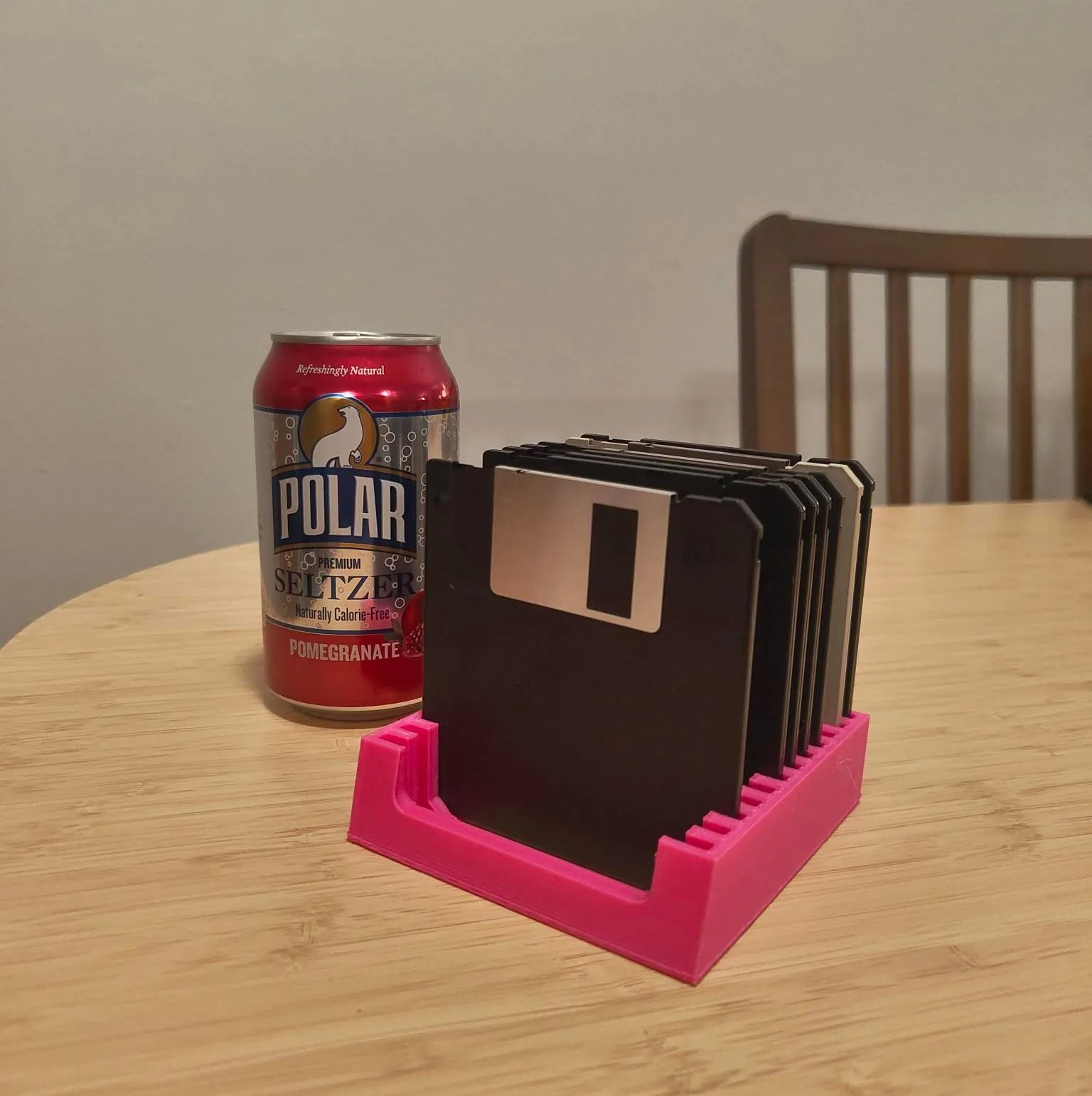
A print I recently designed and made for organizing floppy disks for my Mavica.
In my experience, without an understanding of some form of CAD software, owning a 3D printer is of limited utility. Contrast this with the personal computer: most people who use computers on a daily basis do not know how to program! The typical user can meet most or all of their needs by downloading and utilizing existing software.
I was lucky to learn CAD software in middle school as part of “Technology and Engineering” class, in the golden age where SketchUp was the teaching software of choice instead of TinkerCAD. SketchUp undoubtedly has limitations (I still don’t know how to draw a sphere), and the mechanical engineers I’ve worked with have generally laughed at me for using it. That said, I can reasonably efficiently build things.
Most people I know do not have the motivation or time to learn CAD software just to design and produce one or two parts every few months.
CAD takes a while, too! Designing good parts requires thinking about the direction of layer lines, need for supports (or lack thereof), balance between strength and filament usage/time, and more, on top of just constructing a part that fits the desired functionality and looks pleasant.
Can we make CAD more accessible somehow? The advent of tools like TinkerCAD have certainly helped, but building useful parts within its constraints can be difficult. Maybe generative AI can democratize building shitty 3D models in the same way it democratized building shitty software? The attempts I’ve seen at extending generative AI to CAD haven’t been great.
The whole promise of 3D printing is customized parts built at much faster timescales and with less equipment than otherwise possible. But the typical home user only has the occasional need for a customized part. I use my printer about once a month, sometimes less, mostly because of the time investment of CAD.
#Fitting into the home
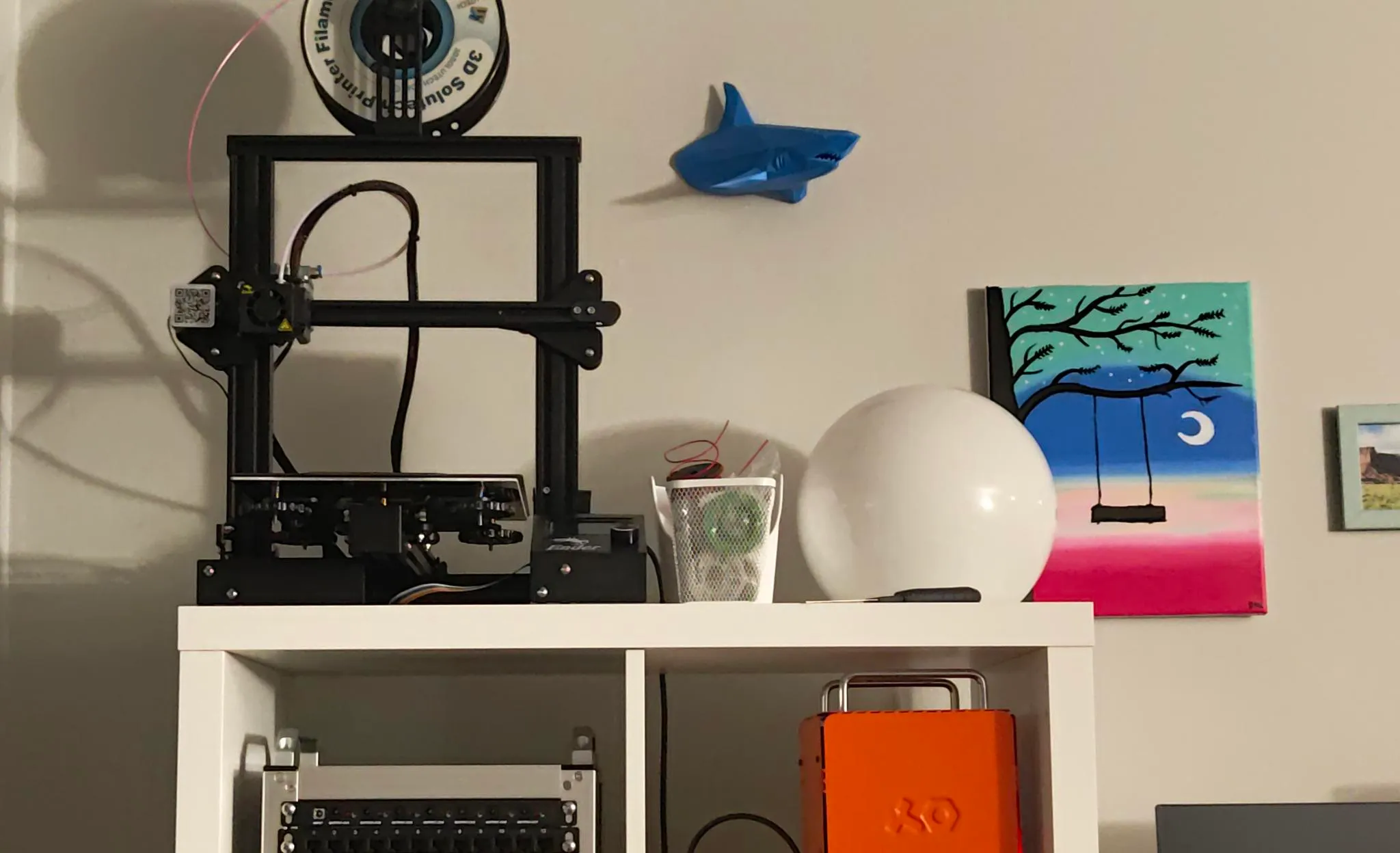
My 3D printer sitting atop an IKEA KALLAX. It is quite big!
Will 3D printers ever be common home appliances?
One could argue that the limited utility of them precludes that being a possibility. But the success of Cricut machines proves that “maker”-oriented devices for the home can be successful! The use cases for the Cricut are similar to those of an FDM 3D printer, they are about a similar size, and the process of using one is similar. But Cricut machines require far less tuning and setup, making useful things on a Cricut requires much less specialized knowledge, and I would guess that Cricut designs have a higher success rate on average than 3D prints.
I think the type of community surrounding hobbyist 3D printing also plays a role. 3D printing fans are often willing to tinker with their printers, want the ability to customize them, and want to bring their own slicer and tooling. That’s great for consumer advocacy, as evidenced by the failure of RFID-chipped vendor-locked filament among all but the most obscure printers. But it tends to direct the innovation in the 3D printing space towards chasing ultimate customization and featureset instead of building a cohesive user experience like Cricut has. I recognize that buying cheap hobbyist-oriented printers makes me part of this problem, but ultimately, that’s the type of printer that fits most home users’ budgets.
I really love owning a 3D printer! And I really wish I got to use it more. I am a huge fan of customizing my living space to fit my life with objects that exactly meet my needs, fit my aesthetic, and work with the other objects in my home. 3D printing allows me to do this, and I think that’s wonderful.