How to create an emoji?
· breq.dev
In 2007, the Unicode Technical Committee decided to assign codepoints to pictographic symbols used by Japanese cellular carriers (SoftBank J-Phone, NTT DoCoMo, and au by KDDI) in an effort to improve interoperability. This one move would set in motion a chain of events leading to both the most drastic change in written communication in recent history and the creation of the lowest-scoring animated film ever produced.
19 years later, Mia and I submitted a proposal for a new emoji, combining both the playfulness of 🐕 (DOG, U+1F415) with the whimsy of 🎈 (BALLOON, U+1F388) to create an emoji for BALLOON DOG. If approved, this emoji could have revolutionized online communication at a scale never before seen. Sadly, the UTC rejected our proposal, and our world will never know what could have happened had this emoji received a codepoint.
This article goes into depth on both how emoji came to be, how new emoji are created each year, and how the manner in which emoji are created has changed over the past years.
#Where did emoji come from?
In the beginning, emoji were copied directly from sets made independently by the aforementioned Japanese carriers. This initial set of emoji was not particularly cohesive, and the emoji themselves were clearly designed around a Japanese audience instead of a global one.
| Emoji | Source |
|---|---|
| 🗾 Map of Japan | KDDI |
| 🗻 Mount Fuji | DoCoMo, KDDI, SoftBank |
| 🗼 Tokyo Tower | KDDI, SoftBank |
| ㊙️ Secret | DoCoMo, KDDI, SoftBank |
| 🏩 Love Hotel | KDDI, SoftBank |
Characters from the Association of Radio Industries and Businesses’ STD-B24 character set, widely used for Japanese-language broadcasting, were later included as well. These mostly covered weather and map symbols.
| Emoji | Source |
|---|---|
| ☂️ Umbrella | ARIB |
| ⛩️ Shinto Shrine | ARIB |
Later on, some symbols were pulled in from both Zapf Dingbats and Microsoft’s Wingdings and Webdings fonts.
| Emoji | Source |
|---|---|
| 📭 Open Mailbox with Lowered Flag | Wingdings |
| 🔈 Speaker | Webdings |
| ❣️ Heart Exclamation | Zapf Dingbats |
Once emoji started to gain popularity more globally, clear gaps began to emerge. Based on unorganized direct requests, the Unicode Consortium added a batch of 80 emojis simultaneously. Many of these symbols were added to represent cultural ideas and symbols outside of the original Japanese audience.
| Emoji | Source |
|---|---|
| 🧕 Hijab | L2/14-174R |
| 🏒 Hockey Stick | L2/14-174R |
| 🌮 Taco | L2/14-174R |
| 🥐 Croissant | L2/14-174R |
| 🕍 Synagogue | L2/14-174R |
Additions since then have trickled in at a slower pace, first through ad-hoc suggestions, then later through formalized proposals handled by a designated Emoji Subcommittee.
#How the emoji proposal process works
Presently, there are three ways to create a new Unicode character:
- For most characters (writing systems and scripts), submit to the UTC Script Encoding Working Group.
- For flags, create a new country with an ISO 3166-1 code.
- For emojis, submit a proposal to the UTC Emoji Working Group.
Thankfully for us, the emoji proposals process is the easiest of the three — all you need to do is write a PDF proposal and submit a Google Form.
Mia and I decided to propose a “Balloon Dog” emoji, depicting the most iconic product of the art of balloon twisting. I’ll summarize the key points of the proposal below, but feel free to read the full document here.
Requirement 1 is Identification. For this, we needed to come up with relevant keywords for the emoji (balloon animal, celebration, entertainer) and the proposed category (Activities → event).
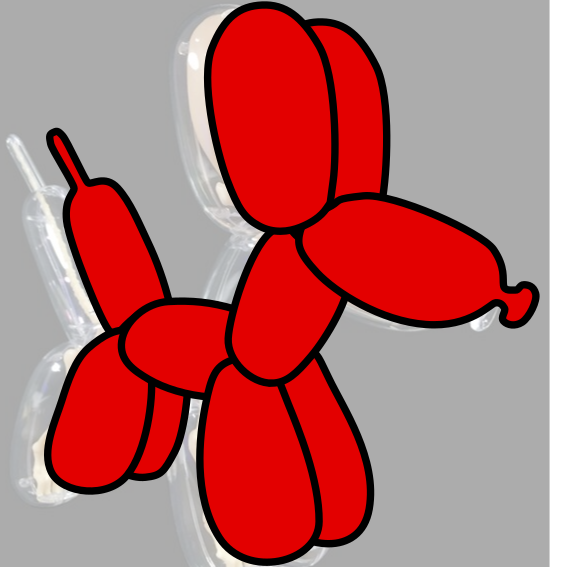
Requirement 2 is Images. We needed to either find suitable public domain images or create our own to depict the emoji. Although I’m not much of an artist, the existing public domain options we could find for “balloon animal” were not particularly good, so I decided to just go for it in Inkscape and see what I could come up with. It’s certainly not perfect but it does get the point across at least!
Requirement 3 is Factors for Inclusion. There are a bunch of points to address:
- Expresses multiple concepts: We leaned on both the literal reference to balloon twisting and the emotional reference to whimsy and playfulness.
- Can be used with other emoji to convey additional concepts: It was fun to think through various examples for this, like showing a hand 🫴 giving someone a balloon animal.
- Breaks new ground: In our case, the new ground was crafts — few emoji represent a craft that can be easily replicated at home in the way balloon twisting can.
- Is legible and visually distinctive: This one was pretty straightforward for us! One important consideration is distinctiveness when shown without color (like it would be in a monochrome font like Noto Emoji).
- Has a high usage level: This section requires searching for the term in Google Search and Google Trends and comparing the resulting numbers against a search for “Elephant” as a baseline. Unfortunately, “balloon dog” did not rank very highly against “elephant.”
- Completes an incomplete category: We pitched our emoji as completing the set of clown-related emoji.
- Is needed for compatibility with popular existing systems: This is generally only applicable if the emoji was available as an emoticon in an existing bulletin board software or chat application.
Requirement 4 is Factors for Exclusion, and has a similar breakdown into categories:
- Already represented: We argued that the ideas communicated by the balloon dog emoji weren’t already portrayed by the round balloon emoji, given the very different visual appearance and vibes.
- Overly specific: In our case, we claimed that the emoji represents a wide range of balloon twisting designs (and is just the most iconic one).
- Open-ended: Emoji that are too specific (UTC uses dog breeds as an example) will cause people to ask why X was chosen over Y, campaign for Y to be an emoji, etc. I think this is kind of the same thing as the previous point.
- Transient: Basically, “is this a fad?” This is probably the reason we don’t have a Shiba Inu emoji, for instance.
- Faulty comparison: The messy origins of emoji mean that many historical emoji would not have been approved today (hence why we have 🗼 Tokyo Tower but no Eiffel Tower).
When writing our proposal, we referenced many existing proposals from previously accepted emoji. While many were old and didn’t match the current format, they were still a useful guide for how to best present our emoji idea.
#Emoji proposals in recent years
When the draft emoji for Unicode 19 were announced, after the initial disappointment wore off of our proposal not being chosen, I took a look at the accepted proposals and was surprised by how old many of them were.
For this chart, I arbitrarily picked Unicode 14 as a starting point due to it being after the initial wave of emoji imports, the establishment of core concepts like skintone modifiers, etc. It seems to be around the time that the emoji proposal process started to stabilize, although I have not been able to confirm that. (Note that there was an extra year between the release of Unicode 15 and 16 due to the COVID-19 pandemic.)
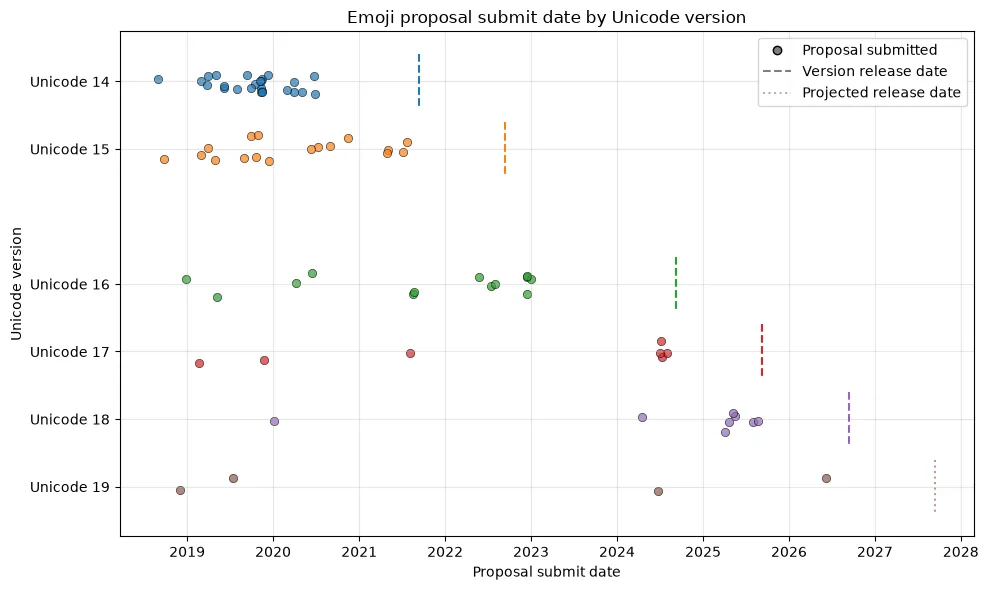
Emoji seem to get stuck “in the pipeline” for a long time, and strikingly, all but one emoji for Unicode 19 are at least two years old at this point. (I’m excluding “Ornate Glass Bottle” from consideration since the proposal did not include the year in the date field.)
The only emoji submitted in the most recent acceptance window that made it into Unicode 19 is “Eyes Looking Right,” which is the same as the “Eyes” emoji 👀 except the eyes look to the right instead of the left. It was proposed by Jennifer Daniel, who happens to be the chair of the Emoji Working Group.
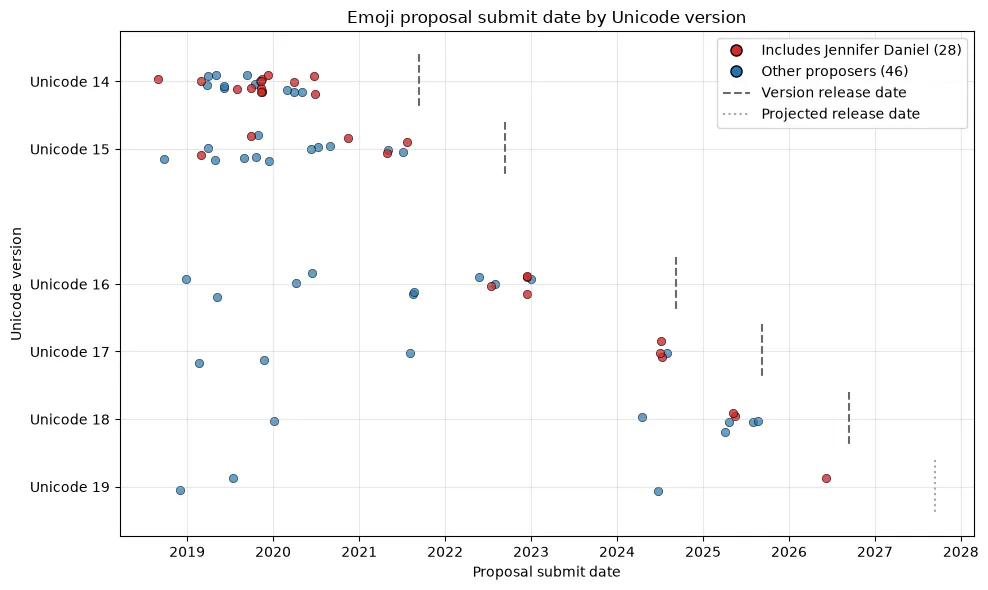
I guess one of the perks of being in charge of the committee is you can just always approve your own proposals.
The Emoji WG does state clearly that they intend to keep reducing the number of emoji added each year to “manage the rapid expansion of the emoji set” and avoid “technical debt.” Consistent with this mindset, this Unicode version has the lowest number of added emoji yet.
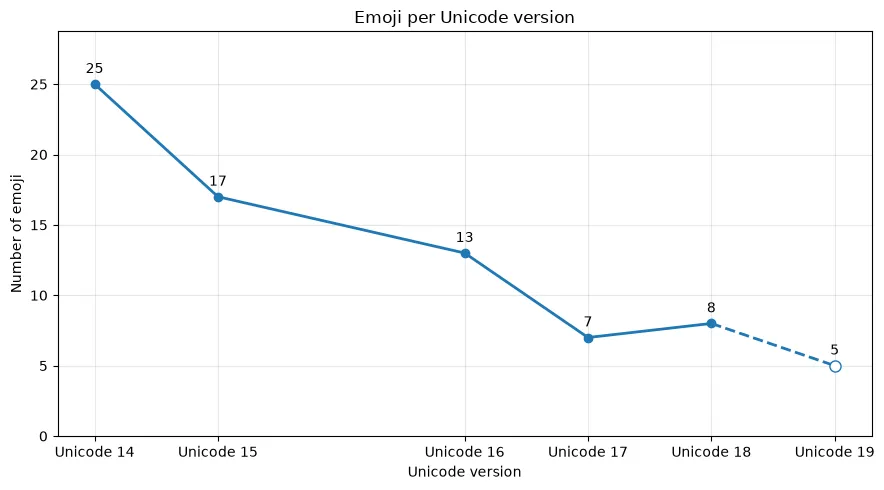
There are 3972 total emoji, so adding 5 emoji in one year is an increase of 0.13%. At this rate, we will achieve a doubling of the emoji library size in about 5 centuries. I understand the impulse to be frugal, but I think the Emoji WG could afford to be a bit less selective here.
Maybe “Balloon Dog” isn’t cut out for being an emoji, but I do feel like we’d be better off with emoji for Traffic Cone, Starfish, Snowmobile, Rubber Duck, Mars, Grapefruit, or Coffee Bean, to pick a few of my favorites from the rejected proposals list. Ultimately, I have a pretty difficult time believing that in the full year leading up to Unicode 19, out of more than 300 proposals in that cycle, the community didn’t have any worthy of inclusion.
Emoji have existed in Unicode for less than 20 years, and the current formalized process for adding more has existed for less than 10 years. Given usage of emoji globally doesn’t seem to be slowing down anytime soon, I think it’s fair to say we’re still in the early days of perfecting emoji in digital communication. If the first decade of emoji brought a flood of new designs, and the second decade did a hard over-correction towards stagnation, perhaps the third decade will be a gentle nudge back towards a healthy rate of new emoji creation.